No Surprises Act IDR Changes
Group health plan sponsors – particularly sponsors of self-insured plans – should prepare for a series of operational changes to the federal independent dispute resolution (IDR) process under the No Surprises Act.
The changes do not take effect all at once. Some requirements are already in effect, while others begin later this year or will be triggered by future implementation of the federal IDR Gateway. This staggered rollout makes coordination with TPAs and other service providers particularly important.
Background
The No Surprises Act generally protects participants in group health plans from unexpected bills for certain out-of-network emergency services and other covered services received in circumstances where patients may have little or no ability to choose an in-network provider. Instead of allowing providers to bill patients for amounts above applicable cost-sharing, the law generally requires payment disputes between plans and out-of-network providers to be resolved through a structured process that begins with a 30-business-day open negotiation period and, if no agreement is reached, may proceed to federal independent dispute resolution, where a certified IDR entity selects between the parties’ competing payment offers.
The Departments of Health and Human Services, Labor, and the Treasury (collectively, “the Departments”) are now revising that process to make it more efficient, transparent, and administratively workable, including by standardizing information exchanged between the parties, clarifying eligibility and batching rules, improving electronic processing through the IDR Gateway, and reducing disputes and delays that have contributed to a significant IDR backlog.
What Is Changing?
Administrative Fee Drops to $15
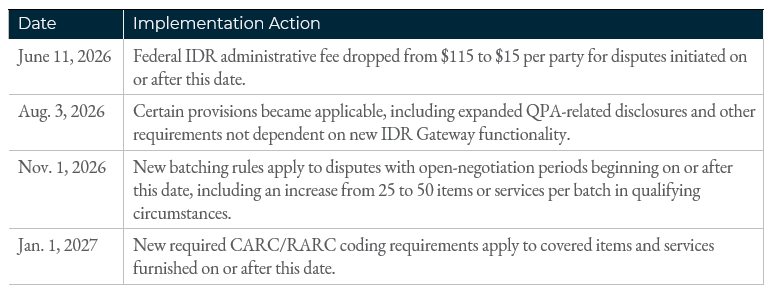
For federal IDR disputes initiated on or after June 11, 2026, the administrative fee paid by each party decreased from $115 to $15. The lower fee could make federal IDR more economical for lower-dollar disputes and may contribute to increased dispute volume.
Expanded QPA Disclosures
The final rule expands the information plans and issuers must provide in connection with the qualifying payment amount (QPA), including information about the open-negotiation and federal IDR process. These requirements are intended to give providers more information earlier in the process and reduce avoidable disputes.
New Batching Rules
The rule increases the maximum size of qualified IDR items that may be included in a single batched dispute from 25 to 50 items or services and revises the standards for which claims may be grouped together. The changes are intended to make the IDR process more efficient while allowing related disputes to be resolved together.
Standardized Claims Coding
Plans and issuers must use specified claim adjustment reason codes (CARCs) and remittance advice remark codes (RARCs) for certain out-of-network claims. The standardized codes are intended to make it clearer whether a claim is subject to the No Surprises Act and eligible for federal IDR.
New Registration Requirement for Self-Insured Plans
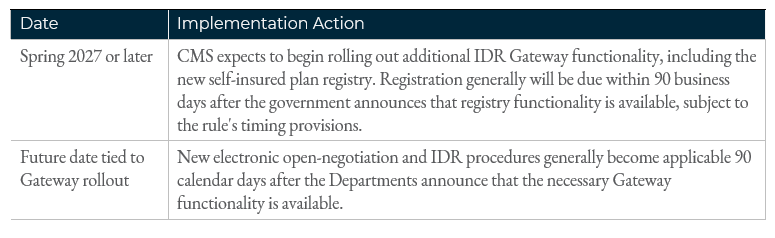
The final rule creates a federal IDR registry that will include self-insured group health plans. The registry is intended to give providers and facilities reliable plan identification and contact information and help determine whether a dispute belongs in the federal IDR process. Plans will be required to register and receive a designated registration number.
More Structured Open Negotiation and IDR Procedures
As the IDR Gateway is expanded, more of the open-negotiation and IDR process will move into the federal electronic system, with standardized notices, responses, and supporting information. The agencies are making these changes to improve transparency, resolve eligibility issues earlier, and reduce administrative delays and backlogs in the IDR process.
Implementation Deadlines
Action Items for Group Health Plan Sponsors
o Confirm what is already done. Verify with TPAs and claims administrators that the requirements applicable as of Aug. 3, 2026, including expanded QPA disclosures, have been implemented.
o Prepare for Nov. 1. Confirm that IDR procedures will incorporate the revised batching rules for open-negotiation periods beginning on or after November 1, 2026.
o Complete systems work before Jan. 1. Make sure claims administrators are prepared to implement the required CARCs and RARCs for applicable items and services furnished beginning Jan. 1, 2027.
o Review vendor responsibilities. Confirm which party is responsible for claims communications, plan registration, open-negotiation responses, IDR submissions, and deadline tracking.
The key for plan sponsors is not a single compliance date but a staggered implementation schedule running from now into 2027. Sponsors should work with their TPAs, claims administrators, and benefits counsel to give each requirement a clear owner before its applicable deadline.
This information has been prepared for UBA by Fisher & Phillips LLP. It is general information and provided for educational purposes only. It is not intended to provide legal advice. You should not act on this information without consulting legal counsel or other knowledgeable advisors.